

Wright receives APA Distinguished Lifetime Contributions award
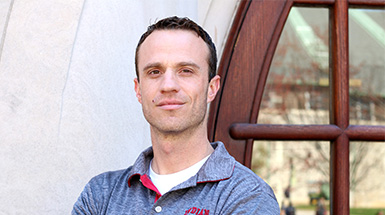
The American Psychological Association’s Society for Media Psychology and Technology has selected Paul Wright for its Distinguished Lifetime Contributions to Media Psychology and Technology Award. The award honors a sustained body of illustrious contributions with major impacts on the study and practice of media psychology and technology.
Wright is a professor and director of communication science in The Media School. His research, inclusive of domestic and international collaborations and supported by both federal and private grants, focuses on the psychology of media use and effects, with a particular focus on socialization processes and impacts on public health.
“The quantity, quality, rigor, far-reaching impact, and formal recognitions of Dr. Wright’s research make him a superb candidate for the Distinguished Lifetime Contributions to Media Psychology and Technology Award,” said Dana Mastro, Wright’s nominator and the executive vice chancellor and provost professor of communication at University of California Santa Barbara.
Wright is a Fellow of the International Communication Association (for distinguished contributions to the broad field of communication), the Association for Psychological Science (for sustained and outstanding distinguished contributions to psychological science), and the American Psychological Association (for unusual and outstanding contributions or performance in the field of psychology). He has been ranked as either the most productive scholar or in the top percentiles of communication and media research productivity in multiple peer-reviewed bibliometric studies and as in the top percentiles of scholarly influence in the field of communication and media studies over the last sixty years.
Other honors received by Wright include the American Psychological Association’s Distinguished Scientific Contributions to Media Psychology and Technology Award, the International Communication Association’s Innovation in Mass Communication Theory Award, the National Communication Association’s Outstanding Health Communication Scholar Award, and the American Academy of Child & Adolescent Psychiatry’s Senior Researcher Award.
He has served in various editorial capacities at scholarly journals across the social and behavioral sciences and is currently editor-in-chief elect at Annals of the International Communication Association.